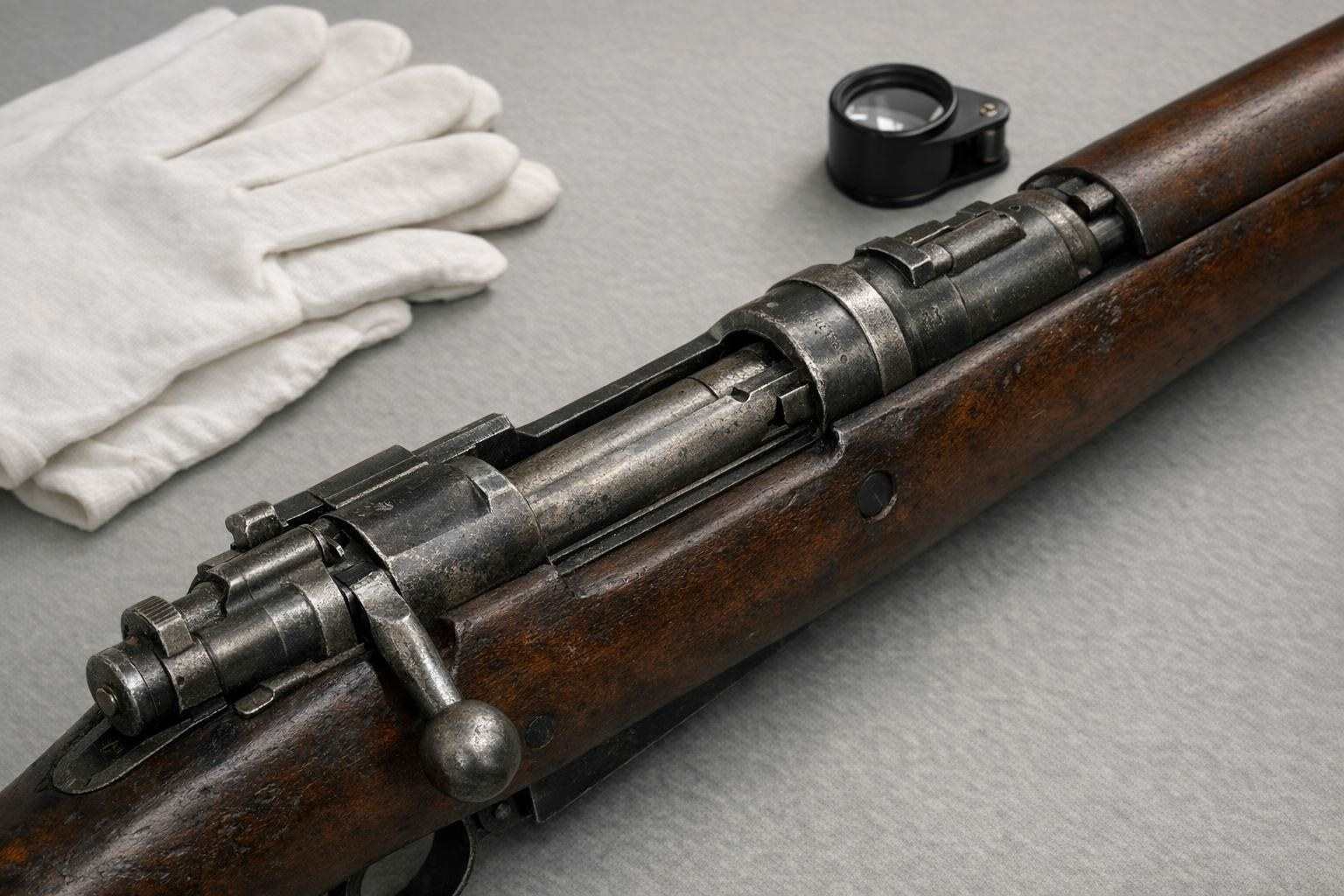

For most such impressions, the information that they convey is limited to recording a single event or occurrence, such as the rifle having passed an inspection by a certain authority. Other marks such as a serial number, proof, etc. also record single instances and are, in effect, 'events' or 'occurrences' which have been 'embedded' in the metal of the rifle at some particular time in its 'life' and hence are of a 'practical' constraint in respect of metal itself.
Different authorities have used different marks for different purposes. So a British broad arrow is not necessarily the same as a German acceptance mark, a U.S. inspector's initials or an importer's stamp. Each mark has to be considered in the light of its position, its form and its context.
Start with the mark's physical position
Serial numbers often are found on the receiver, barrel, bolt, etc. but the various Marks (Proof/Inspection, Acceptance, etc.) which we have been discussing are found in locations where the various Armorer(s) would have found them while performing their duties – e.g., in the manufacturing process or while servicing the firearm in the field.
Instead of immediately jumping to conclusions about what the symbol might prove, begin by asking where the mark was placed on the rifle and what kind of work would have put it there in the first place? For example, marks found on the receiver could indicate original production or some subsequent institutional process, marks on the barrel could relate to the barrel rather than the complete arm, and marks on the bolt can often be used for positive identification of a replacement part.
Even within the limits of metal as a proof medium, the relationship between the marking and the surrounding metal is key. A marking that cuts into older finish, sits atop newly polished metal, or is placed beside marks of a vastly different letter style can denote the work of a later authority. These observations are not necessarily to date an alteration but to ensure that an isolated symbol is not over-interpreted.
Separate identification from provenance
A single mark does not confirm a complete identity. Rather, it establishes a part of the rifle's biography. In order to check whether a rifle is original in respect of all of its parts, all of the numbered components must have the same number, and this number must have been applied in the same manner to each of the components.
When all the numbered components of a rifle match (e.g. the receiver, the bolt, the barrel), this supports the components being original to the rifle, but not necessarily that the rifle was ever carried by a particular soldier in a battle, or issued to a particular unit etc.
Service marks identify different things. For instance, the British broad arrow shows that the rifle was government property at some time, but it does not constitute service evidence of the individual who carried it. German Waffenamt-style service marks denote the rifles that had been through the acceptance process of a specific military armory, but they do not prove that the rifle in question was used in a specific conflict. U.S. service marks identify rifles which were inspected by certain individuals. But after that, they may have gone anywhere.
Be sure to use the correct verb. Words like "indicates," "is consistent with," or "supports" are far more descriptive than the words "proves" or "means." Additionally, be sure to note the difference between evidence and conclusion.
Read serials as a system, not a single number
Serial numbers on parts make better sense when looked at as a group or as a system. Compare the serial number found on the receiver with that found on the bolt, the barrel, the stock, etc. Also, look at the typographic style, the depth of the number, the space between numbers and how the number was applied to the part.
Serial numbers on a rifle's parts can tell different stories. Even if all parts have the same serial number, the style and location of the numbers can differ. This does not necessarily mean that parts were replaced or that the rifle was cobbled together from disparate components. Rather, all of these parts could have been produced by the same defense contractor as part of a larger contract.
Just because a serial number identifies a part to a particular rifle, does not mean that all parts to that rifle identify as that number. If a part has been replaced, then that part will have a serial number identifying it. The collector must study each part to his collector notion of originality and try to determine if other parts were made or installed later.
Treat finish and wear as supporting evidence
The surface of a firearm also tells of its past, though often in a manner that can be negatively affected by cleaning, by being stored, by having been re-finished etc. Then again the same mark can have its edges worn down, and certain parts of it can become smoothed off through wear and tear. Thus though a bright, sharp mark is often taken to indicate a relatively recent application, worn and faded marks can be just as old. Conversely, a fresh, sharp stamp, in a position where it has not been subjected to the same kind of wear as the rest of the firearm's surface, can actually indicate the mark having been applied some time after the firearm was first made. Similarly, a worn and faded mark is not necessarily old. Aggressive cleaning can have the opposite effect of what the person undertaking the cleaning intended, and therefore must be viewed with a critical eye.
It is a matter of proportion when it comes to determining a firearm's originality. A recently applied, bright and sharp-looking mark does not necessarily have to be recent whereas a worn-looking mark does not automatically have to be old. Rebluing or polishing a firearm's surface can remove valuable marks and also clean up the surrounding metal surface thus removing any evidence of a mark having been there prior to the cleaning.
Appearance is not absolute evidence. In most cases, finish assessments can raise questions but not give answers. Other independent evidence, records, examples of similar items and expert examination are needed to verify a finding.
Build provenance from independent pieces
Support historical accounts about a firearm by agreeable independent evidence: the manufacturing or service related marks on the rifle itself plus documented transfers, unit records, veteran's papers, etc. Add period accessories which reproduce when possible and which were used by the same group of people as the rifle itself; but these can only support a period of time for ownership by a particular individual.
So do not confuse identity with provenance (origin) or history. Keep all the different types of evidence that you have for a rifle separate – ie write out the identity marks (and how you interpret them) separately from your written account of provenance.
Document the visible markings, include a reference to where on the object the marking was found, then set out what you consider to be the most reasonable conclusion(s) derived from the marking(s). Limit your conclusions to that which you have been able to verify from the evidence. Take photos of the marks before any cleaning or conservation work is undertaken. Measure and note any damaged, repaired, replaced or re-finised areas on the object. Do not destroy any part of the object in order to attempt to make a clearer mark.
Rifle identification needs to be treated with a sense of restraint, because every historical arm has a finite surface. So, even the most hopeful marks will remain unexplained in many instances. And do not mistake the silences between the various marks for silence on the part of the rifle itself – they are part of the historical evidence too.